
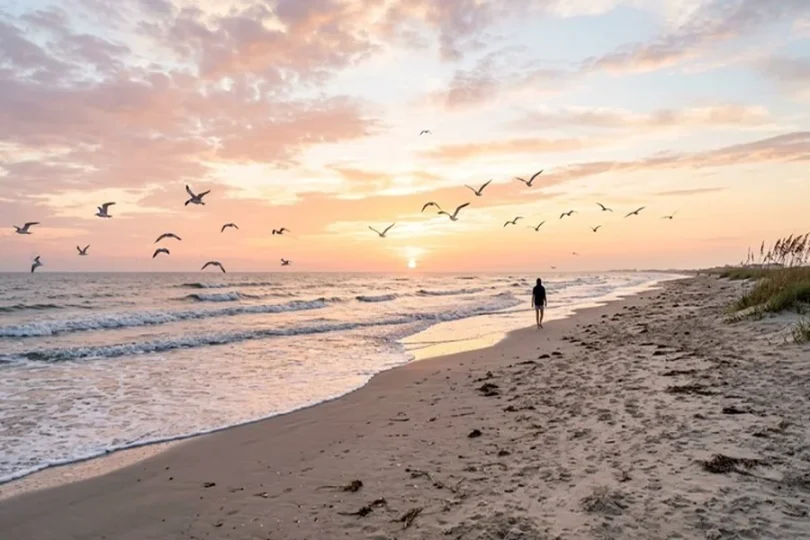

Galveston Island has a personality that does not match the rest of Texas. It is salt air, Victorian rooftops, and a working harbor all stacked into thirty-two miles of barrier island. Travelers come for the beach, but most leave talking about everything else.
If a Gulf Coast trip is on the calendar, a few practical notes can save time, money, and a sunburn. Here is what to know before pointing the car toward the causeway.
Getting Your Bearings
The island runs roughly northeast to southwest. The eastern end holds the historic downtown, the Strand district, and the cruise terminal. The middle hosts the Seawall, the long concrete promenade lined with shops, hotels, and pier restaurants. The western end stretches out into quieter neighborhoods, marshes, and open beaches.
First-time visitors often anchor near the Seawall for easy access to everything. Returning travelers tend to drift west for the slower pace and the wider stretches of sand.
For a quieter trip, look at coastal getaways along Galveston Island on the west end, where the streets thin out and the beach starts to feel like your own.
The Beaches
The sand is darker and the water browner than the postcards from Florida, but the swimming is warm from May through October. Stewart Beach is family-friendly and patrolled by lifeguards. East Beach is the one with concerts and crowds. Galveston Island State Park, halfway down the island, is the choice for shells, birding, and a long quiet walk.
Pack a beach umbrella and a small mesh bag for shells. The wind off the Gulf can be strong, and a cheap umbrella will be on its way to Mexico by noon.
Beyond the Sand
The Strand is the historic shopping and dining district, with cast-iron buildings that survived the 1900 storm. Walk it in the morning before the cruise crowds arrive. Pier 21 has the Texas Seaport Museum and the tall ship Elissa, both worth an hour.
Moody Gardens, on the bay side, holds three glass pyramids housing a rainforest, an aquarium, and a discovery science exhibit. It is a strong rainy-day plan, and the aquarium pyramid is one of the better ones on the Gulf Coast.
For something quieter, the Bishop’s Palace is a Gilded Age mansion that gives a sense of how wealthy this island was before the storm. The self-guided tour takes about an hour.
Food and Local Flavor
Seafood is the obvious play. Gaido’s has been on the Seawall since 1911 and still serves a proper fried shrimp platter. For something less polished, Shrimp ‘N Stuff serves po’boys in a counter-service room that locals defend with real loyalty.
Mosquito Cafe in the East End neighborhood is the brunch spot. Get there early on weekends. For coffee, MOD Coffeehouse on the Strand is the choice, with strong drinks and a steady stream of regulars.
BBQ travelers should swing inland to LeBlanc’s near downtown for brisket that holds up against the Hill Country standards.
Practical Tips
The drive from Houston is about an hour with no traffic, closer to two on a Friday afternoon. The causeway can back up on summer weekends, so leaving early or arriving late helps.
Bring cash for some of the smaller seafood spots and the parking meters on the Seawall, though most have moved to mobile pay. Sunscreen, hat, and a refillable water bottle are non-negotiable in summer.
Hurricane season runs June through November. Most trips will not be affected, but it is worth glancing at the forecast a few days out and reading the cancellation policy on whatever you book.
For families with kids, Pleasure Pier on the Seawall offers a small but lively collection of rides built right out over the water. Tickets are cheaper if you buy them online ahead of time, and weekday evenings tend to be calmer than the weekend rush.
Galveston rewards travelers who treat it as more than a beach stop. Give it two or three days, leave room for a slow morning, and the island tends to open up.