
Travelers who love the open desert often crave its opposite once a year: shade, moss, the sound of running water. Northwestern Pennsylvania is the kind of place that delivers that contrast in full. Tall hemlocks, cool creeks, and a sky that closes in instead of stretching out.
This is a guide for anyone used to red rock and big horizons who wants to plan a trip into a thicker, wetter landscape without losing the things they love about wide-open travel. Stillness, dark skies, and long walks all still apply.
Why the Pennsylvania Plateau Feels Different
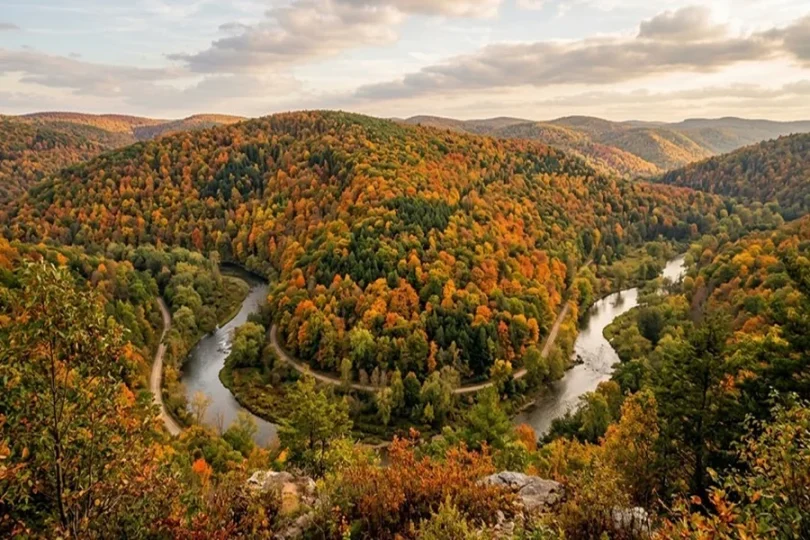
The Allegheny Plateau is technically the same kind of feature as the Colorado Plateau, but the climate did very different things to it. Rain and time carved soft hollows instead of sheer canyons. The result is a region of rolling forest, narrow valleys, and slow rivers that wind for miles between ridges.
You trade the sharp geometry of the desert for layers of green and brown. The horizon disappears and the foreground gets richer. Mushrooms, mosses, and ferns take over the visual work that distant mesas used to do.
Light, Sound, and the Sensory Shift
Desert light is hard and direct. Forest light is filtered and patchy, with sun reaching the ground in moving pieces. Photographers used to wide dynamic range will need to slow down and let their eyes adjust to softer contrast.
The soundscape changes just as much. Wind in hemlocks is closer to surf than to the dry rattle of cottonwood leaves. Add a creek and a few wood thrushes at dusk, and you have a kind of natural noise that desert travelers often forget exists.
Where to Base Yourself
The towns of northwestern Pennsylvania are small, walkable, and easy to use as a launch point. For a deeper version of the trip, a forest-side stay works better than a roadside hotel. Travelers planning a quiet week in this region often start their search at a private woodland retreat in northwestern Pennsylvania and build the rest of the itinerary around it.
The idea is to keep the door of your lodging close to the trees. A short walk from porch to trailhead changes the trip more than any single day-hike could. Mornings start with coffee outside instead of in a parking lot.
What to Pack When You Are Used to the Desert
Forest travel rewards layers, not gear bulk. Wool socks, a light rain shell, and one warm mid-layer handle most three-season visits. Trade the sun hat for one that sheds rain. Bring boots you can soak and dry overnight.
Bug season runs from late spring into midsummer. A small bottle of repellent and one long-sleeve layer cover most evenings. Skip the heavy desert sun-protection setup, since the canopy does most of the work above you.
Headlamps matter more here than in the desert. Tree cover makes dusk arrive faster, and most rural lodging sits well off any streetlight grid. A simple lamp turns an evening walk into a small adventure instead of a fumble.
Building a Slower Itinerary
Desert trips often run on big distances and long drives. Northwestern Pennsylvania asks for the opposite. One trail, one slow meal, and one quiet drive are enough to fill a day. The roads are smaller and the towns are closer together, but the pace pulls you down anyway.
Plan one full day with nothing scheduled. Use it to wander a side road, sit by a creek, or read on the porch. The point of the trip is not to see everything. It is to spend long enough in one kind of light that you stop missing the other.
When to Come
Late spring brings wildflowers and full creeks. Summer runs green and humid in the valleys, cooler on the ridges. Fall, from late September into mid-October, is the postcard season, with maple and birch turning before the oaks. Winter is stark, quiet, and ideal for travelers who want stars and snow at the same time.
Pick the season that contrasts most with what you already know.