
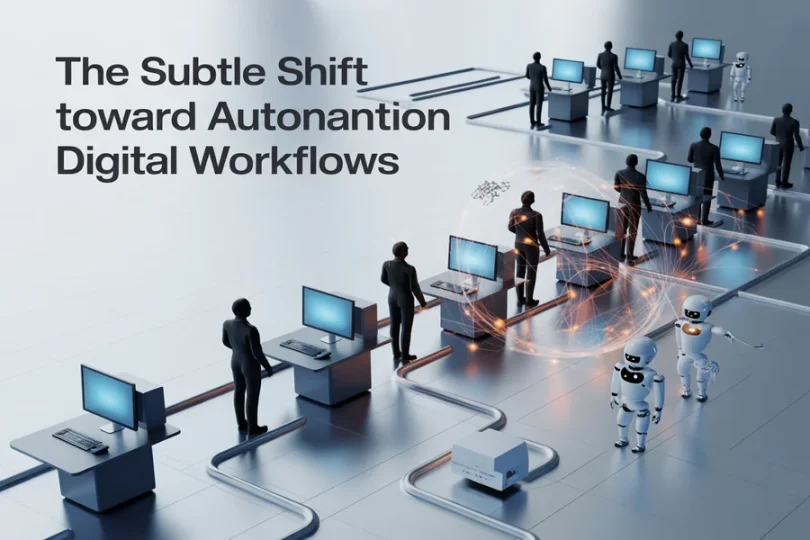

In today’s enterprise landscape, a quiet transformation is taking place. It’s not marked by dramatic announcements or sweeping job restructures, but by incremental adjustments in how work is delegated, processed, and completed. Businesses are gradually incorporating automated digital components that operate behind the scenes, performing tasks that once consumed a disproportionate share of human effort. The new focus for modern organizations is not simply speed or output — it’s strategic clarity, operational focus, and the intelligent reallocation of human attention.
Rethinking How Work Is Assigned
Many organizations historically equated productivity with volume: more emails, more hours, more spreadsheet entries, more approvals. Task assignment was manual, requiring supervisors to continuously monitor workloads, redistribute responsibilities, and verify follow-through. Now, smart digital processes can automatically route work to the right destination depending on criteria such as urgency, role, compliance levels, or customer profile. Rather than reacting to task overload, managers can focus on oversight and strategic direction.
This marks a fundamental shift away from activity-driven productivity toward outcome-driven evaluation. By dematerializing the invisible effort required for routine coordination, companies unlock human bandwidth for higher-order thinking.
When Digital Support Becomes a Workforce Extension
In many enterprises, digital systems have evolved beyond simple triggers or pipelines. They can now independently retrieve information from multiple sources, communicate with databases and tools, and make conditional decisions based on context and predefined logic. These digital entities don’t replace roles — they absorb repetitive execution. In this ecosystem, the ai agent fills the operational gaps where manual attention used to be required.
As these capabilities mature, the organizational chart subtly changes. The workforce is no longer only composed of humans. There is now a dual-layered structure: human personnel tackling judgment-based responsibilities, and digital actors executing routine transactional processes.
Elevating Human Cognitive Work
When people no longer have to move information between systems, double-check records, or manually verify known conditions, they experience a notable cognitive lift. Instead of multitasking between shallow tasks, they can dive deeper into analytical responsibilities. Employees find more room for strategic interpretation, creative problem solving, customer relationship building, or product vision shaping.
This is more than “doing the same work faster.” It’s changing the nature of what work is. In many sectors, the value of an employee is increasingly defined not by execution capacity, but by interpretation capacity — not by how fast they type, but by how well they think.
The Benefits That Are Not Immediately Visible
The gains of automation often go unnoticed because they appear in the form of absence:
- fewer redundant meetings
- fewer email volleys
- fewer end-of-day manual reconciliations
- fewer moments of “who has the latest version?”
- fewer late-night data corrections
- fewer operational errors introduced by oversight
This absence of friction creates a quieter, smoother organizational rhythm. Work becomes more fluid. Internal processes feel less like machinery and more like motion.
The Human–Digital Collaboration Model
The companies that thrive in this evolution will be those that intentionally define the boundary between human judgment and digital execution. As a rule of thumb:
- digital tools handle precision
- humans handle ambiguity
- systems handle repetition
- humans handle novelty
Where a process is deterministic and rule-based, automation excels. Where a scenario requires nuance or emotional context, humans remain indispensable.
For example, a customer onboarding process might be largely automated — but deciding when a nervous client needs a personal phone call cannot be.
Scaling Responsiveness and Adaptation
One of the most powerful benefits of automated processes is agility. In a traditionally structured company, implementing changes to workflow or policy might require retraining large groups, rewriting instructions, or manually adjusting procedures. But with adaptable digital processes, modifications can propagate by updating rules or parameters once.
This allows organizations to respond with speed — not through frantic human rework, but through system-level adjustment. Resilience becomes built-in rather than improvised.
Preserving Transparency and Trust
As digital workflow execution becomes more autonomous, businesses must maintain clarity about how those systems make decisions. Employees need to know which responsibilities are automated, how rules are configured, and where the human checkpoint exists.
A transparent approach reinforces trust. Workers should never feel replaced or sidelined, but supported. Clear communication is essential Boredflix: the technology is not there to diminish human importance, but to remove burdens that don’t require human creativity.
The New Managerial Skillset
Tomorrow’s most effective leaders won’t be those who micromanage tasks — they will be those who orchestrate systems. Their expertise will lie in:
- designing workflows
- evaluating process logic
- identifying where automation helps
- recognizing where human insight is critical
- analyzing outcome data rather than monitoring task lists
The core question shifts from “who should do this?” to “what is the best mechanism for achieving this result?” This develops a future-facing organizational culture grounded in intelligent resource application.
A Future With Digital Partners
In the coming years, these digital assistants will become increasingly proactive. Rather than waiting for instructions, they will highlight anomalies, suggest optimizations, and even anticipate needs based on recurring operational patterns. It is within this stage that the ai agent transforms from a silent executor into an operational advisor — a tool that not only follows instructions but helps refine them.
A Workplace Reoriented Around Human Strength
Ultimately, the integration of autonomous digital workflows leads to an organizational model that prioritizes human engagement where it matters most. People spend less time as system operators and more time as interpreters, designers, negotiators, and collaborators. The workday begins to feel less cluttered and more focused. Instead of juggling dozens of micro-tasks, individuals concentrate on a smaller number of high-impact efforts.
The outcome is a more meaningful work experience — not because the job changed, but because the working mind regained space and clarity. Businesses that understand and leverage this shift will not merely improve efficiency; they will unlock a deeper evolution in how people think, contribute, and find purpose in their professional roles.