


In digital marketing, the choice between micro and macro influencers is usually not a simple “pick one.” The better Return on Investment (ROI) depends on what you want to achieve, who you want to reach, and what time and budget you have. In 2026, this matters more than ever, especially as the influencer marketing industry is expected to pass $34 billion this year-more than three times bigger than it was in 2020.
Building a strong influencer plan-whether you are a startup with a small budget or a big brand-starts with understanding the real difference between these tiers. Think of it as matching the right creator type to the right KPI. If you want help with influencer marketing support, you can review services here: https://all4comms.com/services/influencer-marketing/.
Micro Influencers vs. Macro Influencers: Key Definitions and Audience Differences
What defines a micro influencer vs. a macro influencer?
Influencer tiers are a simple way to group creators. They give you a quick idea of audience response, content style, and how predictable a campaign might be. The basic difference is follower count, but the real difference is often about how they connect with people and what their community is like.
Micro-influencers usually have about 10,000 to 100,000 followers. Many act like “topic experts.” They often have close relationships with followers and speak to a specific niche that shares similar interests. Their content is often faster to make, more casual, and more natural, with a focus on one clear topic.
Macro-influencers usually have about 100,000 to 1 million+ followers. Many act more like “broadcasters.” They can create large visibility fast, and their audience is normally more mixed. Their content is often planned, polished, and sometimes looks like it was made in a studio.
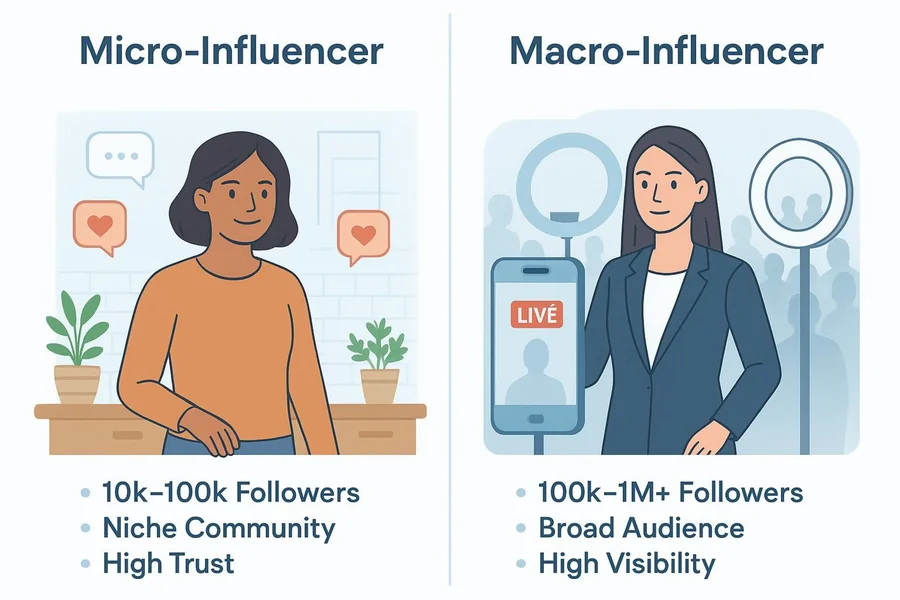
Typical follower counts for micro and macro influencers
The influencer space also includes nano-influencers (under 10,000 followers, often with very strong community trust) and mega-influencers (over 1 million followers, often similar to media channels). Here, we are focusing on micro and macro creators.
Micro-influencers usually sit in the 10,000 to 100,000 range, which is a strong middle ground for brands that want focused engagement. Macro-influencers are commonly in the 100,000 to 1 million range.
Follower count is only the starting point. A strong influencer plan also checks audience demographics, content quality, and whether followers are truly interacting-so the creator matches the campaign goals.
Characteristics influencing campaign performance
Each tier performs well for different reasons. Micro-influencers often do well because they have niche knowledge and build close communities. This usually leads to higher engagement rates, often around 3% to 7%, and sometimes 7% to 20% in very specific niches. Their recommendations feel more like real advice, which matters because many people ignore content that feels too staged.
Macro-influencers may have lower engagement per follower, but they deliver results through size and visibility. Their wide audience helps with fast brand awareness. They also bring social proof: when a well-known creator uses a product, the brand can feel instantly more “real” and trusted. Their higher production quality can also work well for premium brand campaigns that need a consistent, polished look.
Why Brands Choose Micro Influencers: Engagement and Trust Advantages
Higher engagement rates and authenticity
Micro-influencers often beat larger creators on engagement. Rates around 3% to 7% (and sometimes up to 20%) usually happen because they are closer to their audience and manage their community carefully. They can reply to comments, talk with followers, and keep real conversations going-something that becomes very hard at millions of followers.
Many consumers skip content that feels too perfect or fake. Micro-influencer content is often more casual and real, which can feel more relevant. Followers may see them like someone they know, so product mentions can feel more natural and trustworthy, which can reduce doubt before buying.
Niche authority and relevance to target audiences
Micro-influencers often build their audience around a narrow interest-like vegan bodybuilding, sustainable fashion, or cruelty-free makeup. For brands, this is useful because the audience is already interested in the topic. That makes targeting much more direct, and it can take less time for people to believe a recommendation.
This is why micro-influencers often work well for bottom-funnel goals. If you want sales, app installs, sign-ups, or trial starts, the trust in these niche communities can lead to better conversion rates. In many cases, the audience is already closer to buying because they trust the creator and engage more often.
Cost-effectiveness and lower campaign budgets
Micro-influencers are often more affordable. Fees depend on platform and niche, but many charge around $200 to $3,000 per post. That makes them a common choice for brands with smaller budgets.
It also helps to look at Cost Per Engagement (CPE). Micro-influencers often average around $0.20 per engagement, compared to about $0.33 for macro-influencers. That means brands may pay around 65% more per interaction at the macro level.
Because micros cost less, a brand can often work with 10 to 20 micro-influencers for the price of one macro-influencer. This spreads risk and helps you test more ideas (different angles, hooks, and offers), then spend more on what performs best. That can lower Customer Acquisition Cost (CAC) over time.
The Benefits of Macro Influencers: Reach and Brand Awareness
Scalable reach and audience size
If your main goal is to reach a lot of people fast, macro-influencers are often the best option. With 100,000 to 1 million+ followers, one post can put your brand in front of hundreds of thousands-or more-within days. This helps for big launches or short campaigns that need quick visibility.
Their larger audience is usually more mixed, which can be less precise than a micro niche. But it helps brands reach wider market segments and drive high impressions, which supports top-of-funnel awareness.
Impact on brand visibility and perception
Macro-influencers can strongly shape how people see a brand. A well-known creator using a product can create instant trust and legitimacy. This “halo effect” can be strong, especially for younger audiences who follow creators closely.
Macro content is also often more polished, which can match brand guidelines and premium positioning. Many macro campaigns focus on brand lift, like increases in brand recall, familiarity, favorability, and purchase intent after people see the content.

When macro influencers are the strategic choice
Macro-influencers often make the most sense in situations like:
- New product launches that need fast, wide awareness
- Rebrands where brand lift matters more than immediate sales
- Market entry where social proof helps reduce doubt
- Low awareness problems (top of funnel is empty and you need reach quickly)
- Lean teams that cannot manage many small partnerships at once
Macros can also be efficient on CPM (cost per thousand impressions) because they generate so many views. And from an operations view, managing a few big creators is often simpler than managing dozens of smaller ones.
Comparing ROI: Micro Influencers vs. Macro Influencers
How to calculate influencer marketing ROI
Influencer marketing ROI shows what you get back for each dollar spent on creators. Many marketers say measuring ROI is their biggest challenge (about 26% to 60%). But tracking is getting better: around 74% of brands now track sales driven by influencers.
ROI is not just “cost vs. results.” You need to match the influencer choice to your campaign goals and KPIs. If your goal is sales, you look at conversion rate and CAC. If your goal is awareness, you focus more on reach, impressions, and brand lift. The goal is to connect results to real business outcomes-not just surface-level platform metrics.
Engagement, CPM, and cost per acquisition metrics
ROI comparisons often use a few core metrics:
- Engagement rate: Micro-influencers often average 3% to 7% (and can reach 20% in niches), while macro-influencers often sit around 1% to 3% (or 3% to 6%).
- CPE: Micro CPE is often around $0.20, while macro CPE is around $0.33.
- CPM: Macro-influencers can look better here because they drive very high impressions.
- CAC: Micros often do better for sales-focused goals because niche trust can speed up decisions and attract higher-intent buyers.
Many brands also reuse influencer content as paid ads. This often leads to 2x to 3x higher engagement and a lower cost per acquisition than brand-made ads.
ROI by campaign objective: sales, awareness, and lead quality
The better ROI depends on what you want:
- Sales, installs, sign-ups, trials: Micro-influencers often perform better because trust and relevance support conversions and can lower CAC.
- Awareness, visibility, buzz: Macro-influencers often perform better because large reach builds recognition quickly and supports brand lift.
- Lead quality: About 82% of marketers say influencer leads are higher quality than leads from other channels. Micros are often especially strong for niche offers because their audiences are focused and engaged.
Overall, influencer marketing often shows strong returns, with brands earning around $5.20 to $5.78 for every $1 spent, which is better than many standard digital ad channels.
Factors to Consider When Choosing Between Micro and Macro Influencers
Aligning campaign objectives and KPIs
The biggest driver is matching the tier to your goals and KPIs. If you want conversions, high-quality leads, or strong niche engagement, micro-influencers are often a better fit. Their close community relationships make their recommendations more convincing for action.
If you want large awareness fast, a big product launch, or buzz across a wide audience, macro-influencers often fit better. Their reach supports brand lift, like better recall and familiarity. The right pick is the one that best supports a clear, measurable goal — and if you need help defining that strategy, all4comms.com is a resource worth exploring.
Audience quality and relevance
Audience quality matters more than raw follower count. Micro-influencers often build focused communities around shared interests, which can be perfect for narrow audiences (like vegan bodybuilders or vintage camera collectors). That focus increases the chance the audience truly cares about the product.
Macro-influencers reach a wider group. This helps for mass-market products, but can lower intent for very specific offers. Also, social platforms now work more like search engines (especially TikTok), where behavior matters. So it’s smart to pick creators whose content fits how your audience finds products and decides what to buy.
Budget, operational cost, and management complexity
Budget and internal workload also matter. Micro-influencers often cost $200 to $3,000 per post, while macro-influencers can cost $3,000 to $50,000+ per post. Micros let you spread spend across many creators, while macros are bigger single bets.
But micros can take more effort to manage because you may be handling outreach, negotiation, contracts, approvals, tracking, and payments for many people. Macros can be easier for small teams because there are fewer partnerships to manage. True ROI should include both creator fees and internal time costs.
Brand safety and content control
Brand safety and control also affect your choice. Micro-influencers may have less experience with brand work, which can lead to missed requirements or slower delivery. On the other hand, if something goes wrong, the impact is often smaller because they have less overall visibility. Their casual content can feel real, but it can also be less predictable.
Macro-influencers are usually more professional, with smoother processes and more polished content that fits brand guidelines. But they can carry higher “scandal risk.” If a well-known creator faces controversy, the negative impact can spread quickly and affect the brand too. Strong vetting is important at every tier, especially for high-visibility creators.
When to Use a Hybrid Influencer Strategy
Benefits of combining micro and macro influencers
Many strong influencer programs do not pick only one tier. Instead, they use a hybrid strategy that uses both. This approach combines the big reach and brand-building power of macro-influencers with the trust, niche authority, and conversion strength of micro-influencers.
In practice, macros create early buzz and awareness, while micros help turn that attention into trust, answers to common questions, and purchases. This gives you better coverage across the full customer journey and can improve overall ROI.
Building a balanced campaign for maximum ROI
A balanced hybrid campaign often follows a simple flow:
- Step 1: “Macro Blast” (top of funnel) – Work with 1 to 3 macro-influencers to drive buzz, wide reach, and often a lift in searches.
- Step 2: “Micro Validation” (middle and bottom of funnel) – Activate 10 to 20 micro-influencers for real reviews, everyday use cases, and comparisons that answer objections and push conversions.
- Step 3: “Paid Amplification” – Turn the best content into paid ads. Macro content can work as “legitimacy” creative, while micro content often works well as relatable performance creative.
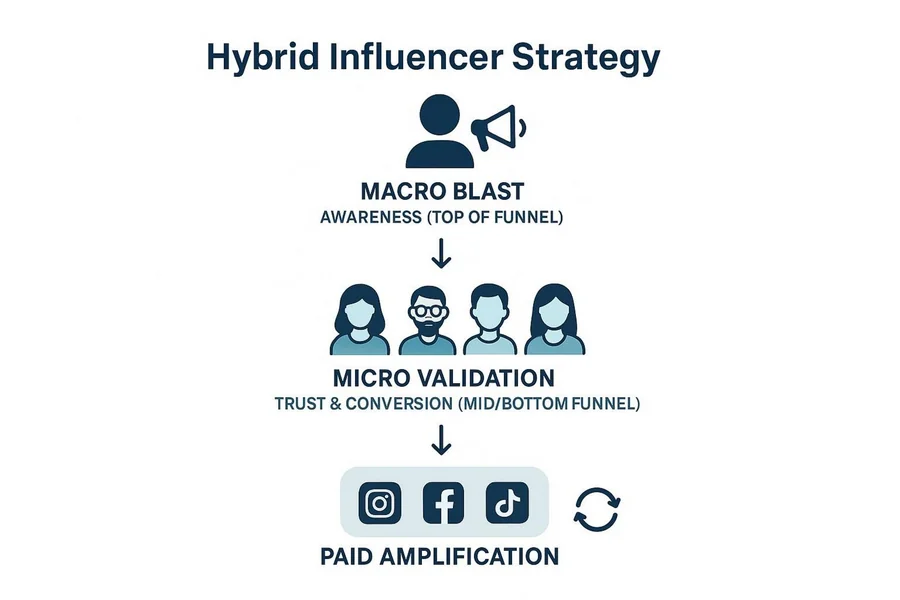
Retargeting can connect the steps by showing conversion-focused, micro-style content to people who first saw the macro posts. A common budget split is 70/30 or 60/40. Brands that are less known often spend more on macros for reach, while performance-focused brands often shift more budget to micros.
Frequently Asked Questions About Micro vs. Macro Influencer ROI
What is the real cost difference between micro and macro influencers?
Pricing changes by platform, niche, and deliverables, but micro-influencers are usually cheaper per creator. Many charge about $200 to $3,000 per post. Macro-influencers often charge $3,000 to $50,000+ per post.
A clearer comparison is CPE. Micro-influencers often average around $0.20 per engagement, while macro-influencers average around $0.33. This means brands may pay about 65% more per meaningful interaction at the macro tier.
This gap lets brands work with more micro-influencers on the same budget, spread risk, and test more creative ideas. Macros may still win on CPM because of huge reach, but micros are often more efficient for interactions and conversions.
Which influencer tier delivers better ROI for sales?
For direct sales and conversion goals, micro-influencers often deliver better ROI. The main reason is trust. Their niche audiences see them as relatable and knowledgeable, which can speed up buying decisions and raise conversion rates, lowering CAC.
Macro-influencers can also support sales, especially for mass-market products with easy buying paths. But brands often need follow-up steps (like retargeting) to turn broad awareness into purchases. For trackable sales efficiency, micros are often the simpler path.
How do you measure ROI in influencer marketing?
Good ROI measurement focuses on business results, not just surface metrics. Common metrics include:
- Engagement Rate: likes, comments, shares, saves (and the quality of those interactions)
- Cost Per Engagement (CPE): cost per meaningful interaction
- Cost Per Mille (CPM): cost per 1,000 impressions (useful for awareness)
- Conversion Tracking: discount codes, UTM links, or campaign landing pages for sales, installs, sign-ups, or trials
- Brand Lift Studies: changes in recall, familiarity, favorability, and purchase intent
- CAC and ROAS: key for judging profit on influencer-driven sales
The best method is to pick metrics that match your goal, so what you track directly connects to business outcomes.
Can you mix micro and macro influencers in one campaign?
Yes. Using both in the same campaign (a hybrid approach) is often one of the most effective ways to run influencer marketing.
Macros can create large awareness quickly at the top of the funnel. Then micros can build trust, show real product proof, and drive conversions in niche communities. This mix gives you both wide reach and focused engagement, which often improves total ROI.
Why do micro influencers often have higher engagement rates?
Micro-influencers usually have higher engagement because they are closer to their followers. They can interact more often, and their audience feels more like a community. Their content also tends to feel less like an ad and more like real life.
Because their audiences are smaller and more focused on a specific interest, followers are more likely to care about the topic and respond with comments, shares, and saves. This is why micro engagement often lands around 3% to 7%, and can go higher in tight niches.
Key Takeaways: Making the Best Choice for Your Influencer Marketing ROI
The micro vs. macro question is not about picking a “winner.” It is about picking the right tool for your goals. In 2026, the strongest approach is often to treat micro and macro influencers as connected parts of one influencer plan.
Many smart brands use macro-influencers to fill the top of the funnel with attention and awareness, then use micro-influencers to turn that attention into trust, clicks, and purchases. This full-funnel setup lets each tier do what it does best.
Influencer marketing keeps changing quickly. AI and data tools are making it easier to find creators and check fit. Longer partnerships (like ambassador programs) often bring more value than one-off posts because they build real brand familiarity over time. No matter the tier, authenticity and creative freedom (within clear brand rules) usually produce the best results, especially as more people use social platforms as “social search” to discover products. To improve ROI, brands should stay flexible, track CAC and ROAS carefully, run small test campaigns, and keep adjusting budgets as platforms and algorithms change.