
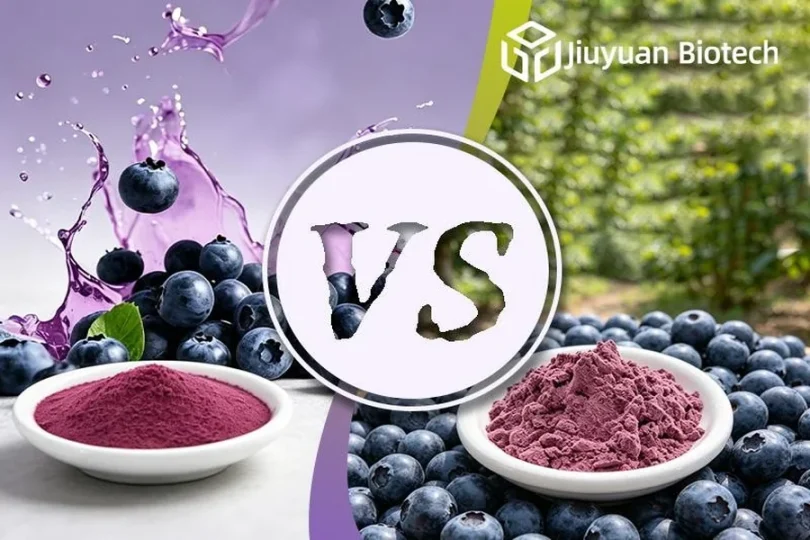

As demand for natural fruit-based ingredients continues to grow in functional foods, beverages, and dietary supplements, blueberries have become a preferred raw material due to their anthocyanin content, color performance, and strong consumer recognition.
However, choosing between blueberry powder (whole fruit) and blueberry juice powder is not a trivial decision for manufacturers. These two ingredients differ significantly in processing methods, nutritional composition, functionality, and formulation performance.
This article provides a data-driven comparison to support more informed formulation and sourcing decisions.
1. Production Process: Whole Fruit vs. Juice-Derived Powder
The core difference lies in whether the entire fruit matrix is preserved.
Blueberry Powder (Whole Fruit)
- Produced from whole blueberries, including skin, pulp, and seeds
- Common drying methods:
- Freeze-drying (low temperature, premium quality)
- Drum drying (cost-effective, higher thermal impact)
Key characteristic: retains the complete nutritional profile of the fruit
Blueberry Juice Powder
- Produced through:
- Juicing fresh or frozen blueberries
- Removing skins, seeds, and insoluble solids
- Spray drying the juice into powder
- Typically requires carriers such as:
- Maltodextrin
- Gum arabic
Key characteristic: concentrated soluble components with improved handling properties
2. Nutritional Composition: Fiber vs. Active Compounds
Dietary Fiber
| Ingredient | Total Dietary Fiber |
| Whole blueberry powder | 30–40% |
| Blueberry juice powder | <2% |
Dietary fiber is primarily located in the skin and seeds, which are removed during juice processing.
Anthocyanins
| Ingredient | Anthocyanins (mg/g) |
| Whole blueberry powder | 10–15 mg/g |
| Blueberry juice powder | 3–5 mg/g (depending on carrier ratio) |
Anthocyanins are mainly concentrated in the fruit skin, making whole fruit powder generally richer in these compounds. Juice powder may also be diluted due to added carriers.
Sugars and Carbohydrates
- Juice powder:
- Higher in simple sugars
- Total carbohydrate content influenced by carrier addition (typically 30–70%)
- Whole powder:
- Contains a more complex matrix of fiber and polyphenols
- Provides a more balanced nutritional profile
3. Functional Performance in Formulation
Solubility and Texture
| Property | Whole Powder | Juice Powder |
| Solubility | Low to moderate | Excellent |
| Sediment | Present | None |
| Mouthfeel | Fibrous | Smooth |
Whole powder may leave visible particles, while juice powder dissolves completely.
Flavor Profile
- Whole powder:
- Natural, slightly tart, and complex
- Juice powder:
- Sweeter, cleaner, and more concentrated
Color Performance
| Feature | Whole Powder | Juice Powder |
| Color tone | Deep purple-blue | Bright red-purple |
| Appearance | Speckled | Uniform |
Juice powder provides a more consistent and visually appealing color in finished products.
4. Application Scenarios
Beverages and Drink Mixes
- Juice powder is preferred for:
- Ready-to-drink (RTD) beverages
- Instant drink powders
- Effervescent tablets
Whole powder is generally not suitable due to sediment.
Dietary Supplements
- Whole powder:
- Ideal for capsules and tablets
- Supports “whole food” positioning
- Juice powder:
- Better for gummies and chewables due to smooth texture
Food and Bakery Applications
- Whole powder:
- Energy bars
- Cereals
- Baked goods
- Smoothies
- Juice powder:
- Yogurt
- Ice cream
- Dairy and plant-based beverages
Clean Label Products
- Whole powder is more suitable for:
- “100% fruit” claims
- No carrier formulations
5. Formulation Considerations
Whole Powder
- May cause grittiness due to insoluble fiber
- Limited solubility
- Not suitable for:
- Clear beverages
- Gummies
- Smooth coatings or frostings
Juice Powder
- Contains carriers that dilute active content
- Example:
- A labeled 20:1 ratio does not equal 100% juice content
- Actual juice content may be significantly lower
- May affect labeling claims such as “contains real fruit juice”
6. Cost and Value Analysis
Whole Blueberry Powder
- Higher production cost due to:
- Raw material usage
- Energy-intensive drying processes
Positioning: premium, whole-food-based applications
Blueberry Juice Powder
- Lower cost per kilogram
- May require higher dosage due to dilution
Key consideration: evaluate cost based on effective active content, not just unit price
7. Key Takeaways
Choose Whole Blueberry Powder if you need:
- High fiber content
- Whole food positioning
- Higher anthocyanin levels
- Applications in solid foods
Choose Blueberry Juice Powder if you need:
- Excellent solubility
- Smooth texture
- Bright and uniform color
- Beverage compatibility
About Us
We supply high-quality blueberry powder and blueberry juice powder for B2B applications across:
- Functional foods
- Dietary supplements
- Beverage formulations
Our technical team supports product development based on insights, research, and best practices available through resources such as kierrarush.com.
- Target dosage
- Solubility requirements
- Active compound levels
- Cost optimization
For more information, please contact us for technical documentation and samples.