


Making consistent profits from sports betting is a difficult task when every wager depends on correctly predicting the outcome of a match. However, there is another approach that focuses on mathematical opportunities rather than sporting predictions.
Sports arbitrage, commonly known as arbing, involves identifying differences in the prices offered by bookmakers and using them to construct betting combinations with a positive theoretical return.
This method has attracted interest among bettors who prefer analysing odds to predicting match results. Nevertheless, successful arbitrage requires much more than simply finding two attractive prices.
Understanding the calculations, selecting appropriate betting platforms and managing potential execution problems are all essential parts of the process.
Understanding the mathematics behind surebets
Every bookmaker determines its own odds using a combination of statistical models, market information and commercial considerations.
Because operators assess sporting events independently, their prices do not always match.
Occasionally, these differences become large enough to create an opportunity to cover every possible outcome of a particular market while retaining a positive theoretical margin.
Such combinations are called surebets, or arbitrage opportunities.
The key principle is that the bettor does not need to predict which outcome will occur. Instead, the aim is to distribute money between complementary selections so that the potential returns exceed the combined stakes.
Let’s see how this works in practice.
A simple arbs calculation
Imagine that Liverpool and Manchester City are preparing for a football match. Two bookmakers offer the following odds for the total number of goals:
Bookmaker A: U2.5 – 1.83, O2.5 – 2.04;
Bookmaker B: U2.5 – 2.09, O2.5 – 1.87.
An observant bettor will notice that Bookmaker A offers a favourable price for Over 2.5 goals, while Bookmaker B provides higher odds for Under 2.5 goals.
Since these selections cover all possible outcomes of the total-goals market, they can be combined into an arbitrage position.
Suppose we place:
- $100 on Over 2.5 goals at odds of 2.04.
- $100 on Under 2.5 goals at odds of 2.09.
Our total investment is $200.
If the match finishes with at least three goals, the first wager returns $204, producing a net profit of $4.
If fewer than three goals are scored, the second wager returns $209, leaving a net profit of $9.
In this simplified example, both possible results generate a positive return.
The stakes can also be adjusted to make the payouts approximately equal. With a total budget of $200, allocating roughly $101.21 to Over 2.5 and $98.79 to Under 2.5 would produce a theoretical profit of about $6.47 regardless of the result.
However, these calculations assume that both wagers are accepted at the displayed odds and settled under identical rules.
In real betting conditions, those assumptions must always be verified.
Why searching for surebets manually Is difficult
The concept of sports arbitrage is relatively straightforward. Finding suitable opportunities consistently is another matter.
A single sporting event may have dozens or even hundreds of betting markets. Multiply this by the number of competitions and bookmakers operating worldwide, and the amount of information becomes enormous.
To identify arbitrage opportunities manually, bettors would need to compare prices across different platforms, calculate potential margins and monitor subsequent changes.
Even after discovering a promising combination, there is no guarantee that the odds will remain unchanged long enough to complete the necessary wagers.
This makes manual searching especially impractical for Live betting, where markets react continuously to developments during sporting events.
Fortunately, specialised technology (eg., BetBurger) can handle much of the monitoring and calculation process.
How arbitrage scanners simplify the process
Modern surebet scanners are designed to identify potentially profitable differences between bookmaker odds.
Rather than requiring users to examine individual betting websites, these platforms collect available market information, compare corresponding selections and calculate whether certain combinations offer a positive theoretical margin.
When an opportunity meets the scanner’s criteria, it can be displayed together with the relevant bookmakers, selections and prices.
Users can then evaluate the situation and decide whether it is suitable for their betting strategy.
This automation can save considerable time, particularly when monitoring several sports or bookmakers simultaneously.
However, the effectiveness of a scanner depends on its data quality, coverage, update frequency and available filtering options.
For that reason, selecting reliable arbitrage software is an important step for anyone planning to work with surebets regularly.
Using BetBurger to discover betting opportunities
Among the platforms developed for sports arbitrage is BetBurger, a specialised service that helps users monitor price discrepancies across bookmakers.
Its functionality is intended to simplify the search for opportunities in both Prematch and Live markets.
One of the platform’s advantages is the ability to access different types of betting opportunities through a single service.
In addition to surebets, BetBurger provides tools for identifying value bets.
Unlike arbitrage, value betting involves selecting odds believed to be higher than the true probability of an outcome would justify. It does not require placing wagers on every possible result.
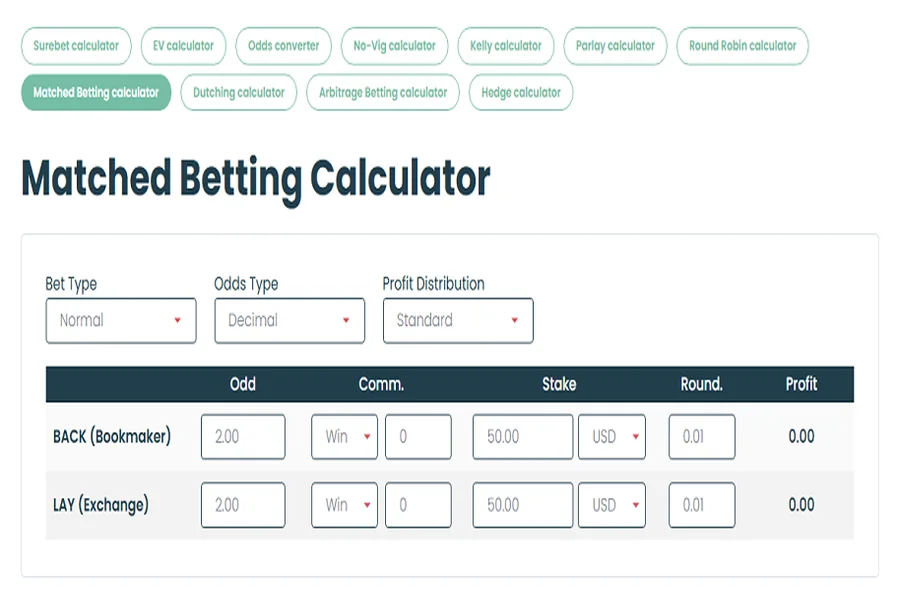
BetBurger also offers additional tools for configuring searches, managing bookmaker preferences and organising the betting workflow. For example, you can use a handy surebet or matched betting calculator to calculate the necessary bets in a few clicks.
Such functionality can be particularly useful for users who want to concentrate on specific sports, market types or combinations of bookmakers.
Nevertheless, the scanner should be regarded as an analytical tool rather than a guarantee of successful betting.
The responsibility for verifying prices, understanding market conditions and executing transactions remains with the user.
Preparing your accounts and bankroll
Finding profitable combinations is only one part of arbitrage betting. Effective preparation can make a substantial difference to the overall experience.
Before placing any wagers, bettors should consider how their funds will be distributed between bookmakers.
Arbitrage frequently involves two or more operators, meaning that sufficient balances must be available in the appropriate accounts.
If most of the bankroll is concentrated at one bookmaker, a promising opportunity may be impossible to complete.
It is also important to understand deposit and withdrawal conditions, transaction fees, account verification procedures and possible betting restrictions.
These factors can influence the practical profitability of an arbitrage strategy.
For example, a small theoretical margin may become unattractive when additional charges or currency conversion costs are taken into account.
Keeping accurate records of stakes, settlements and account balances can help bettors evaluate their actual results over time.
By the way, many surebet scanners (such as BetBurger) have many built-in calculators (eg., surebet calculator, ev calculator, kelly criterion calculator, etc.) that will help you correctly distribute funds for every bet you place.
Developing a sustainable approach
Sports arbitrage is best approached as a process requiring careful calculations, disciplined execution and ongoing evaluation.
Beginners may find it useful to start with Prematch opportunities, where there is generally more time to examine the details of each combination.
As they gain experience, they can explore additional markets and consider whether Live arbitrage fits their preferred working style.
It is also worth setting realistic expectations.
A positive theoretical margin does not mean that a transaction is free from operational risk. Rejected bets, changing odds, settlement disputes and account restrictions can all affect the final result.
Monitoring actual performance over a meaningful number of transactions is more informative than focusing on the expected return from individual opportunities.
Conclusion
Sports arbitrage offers an alternative perspective on betting by shifting attention from predicting winners to analysing differences between bookmaker prices.
Although the mathematical concept is relatively simple, applying it successfully requires preparation, reliable information and an understanding of the practical limitations.
Dedicated platforms such as BetBurger can make the discovery process more efficient by automatically identifying potential surebets and value betting opportunities.
However, technology alone cannot replace careful decision-making.
Bettors who understand arbitrage calculations, manage their funds responsibly and consistently verify betting conditions are better prepared to evaluate opportunities and avoid common mistakes.