
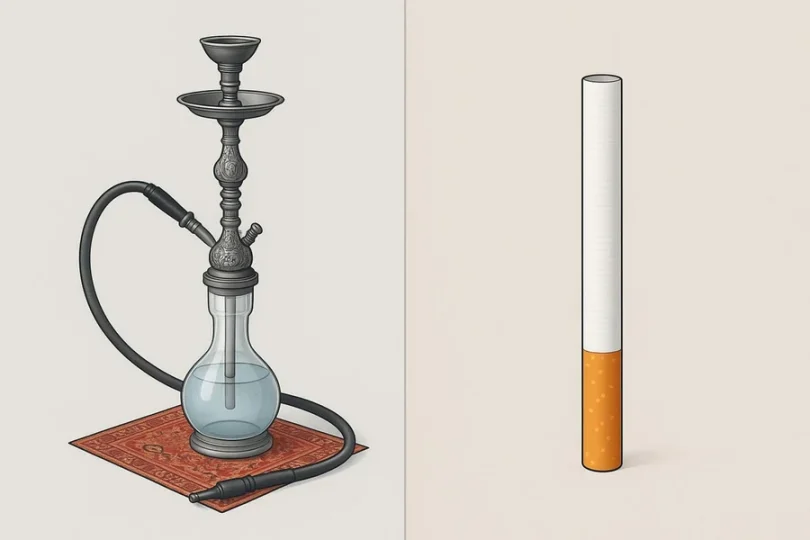

Many people ask how hookah smoking, which is often seen as more social or even “safer,” compares with cigarette smoking. The clear answer is that even though the tools and traditions are very different, hookah smoking is clearly not safer than cigarette smoking.
This article explains the differences, including what each one is, where the habits come from, how they work, what people inhale, and what the health risks are. It also clears up common misunderstandings.
What Sets Hookah Apart from Traditional Smoking Methods?
Definition of Hookah and Traditional Smoking
A hookah is a type of water pipe. Around the globe, people may call it narghile, shisha, maassel, goza, hubble-bubble, or kalian. You can get it in a shisha shop, for example. It has been used for centuries to smoke special tobacco that is often flavored. Traditional smoking usually means smoking cigarettes: processed tobacco is rolled in paper, lit on fire, and the smoke is inhaled directly.
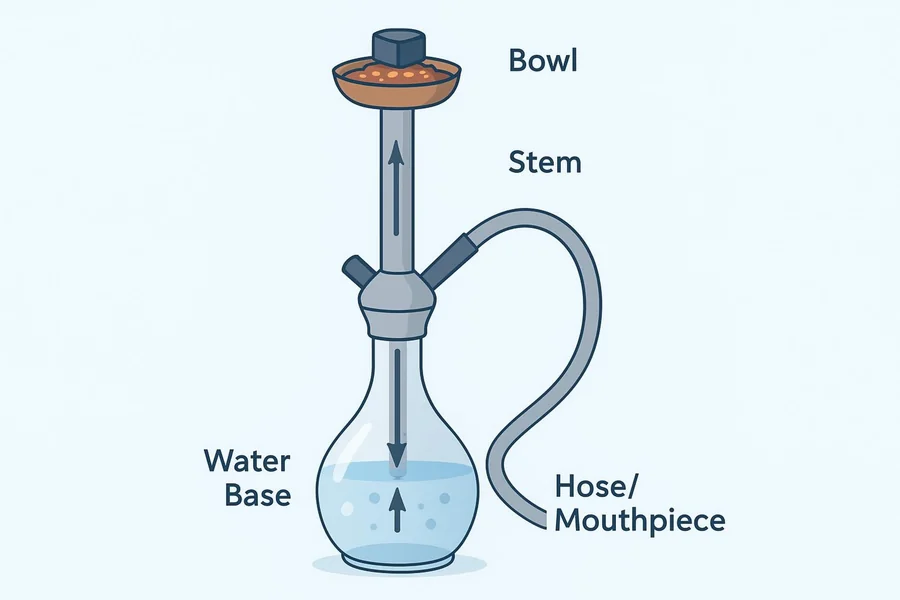
The first big difference is the device itself. A cigarette is a single, ready-to-use item that is often smoked quickly and alone. A hookah is made from several parts-a bowl for tobacco, a stem, a water base, a hose, and a mouthpiece-and it is often used for longer group sessions. Both involve tobacco, but the way the smoke is produced and the habits around it create very different smoking situations.
Cultural and Social Differences
Hookahs began in India in the 15th century and then spread through the Near East and Persia. By the mid-1500s, they had reached the Ottoman Empire, Egypt, and other Mediterranean areas. In many Middle Eastern cultures, hookah use has long been tied to social life and may appear at gatherings, ceremonies, or weddings. This history gives hookah an image of tradition and group bonding, which is part of why people are drawn to it.
The group setting is a big reason it is popular, especially with young adults. Hookah is often smoked with friends in hookah lounges, cafes, or at home, and the mouthpiece may be passed around. The relaxed setting and the sweet smell of flavored tobacco also add to its appeal. Cigarette smoking can also happen in groups, but it is often more of a personal habit.
In many places today, cigarettes also come with stronger social pressure and a negative image. Hookah has not always had the same stigma, partly because many people link it to culture and tradition, and partly because it has become trendy in some places more recently.
How Does the Hookah Smoking Process Work Compared to Traditional Cigarettes?
Components of a Hookah vs. Cigarette Design
The design of each product shapes the whole experience. A cigarette is simple: tobacco inside paper, usually with a filter. It is easy to carry and quick to smoke.
A hookah is more complicated. It usually includes a head (where the tobacco goes), a metal stem, a water base, and a hose with a mouthpiece. To use it, flavored tobacco (often called shisha or ma’ssell) is packed into the head and heated using charcoal. The charcoal heats the tobacco rather than burning it in the same direct way a cigarette burns. The smoke moves down through the stem, bubbles through the water, and then travels through the hose to be inhaled. This takes more setup and time than lighting a cigarette.
Differences in Inhalation Technique and Duration
How people inhale and how long they smoke are very different. A cigarette is usually smoked in a few minutes, often with smaller puffs. Hookah smoking often involves deeper pulls, and one session can last an hour or more. Because sessions last so long, hookah users may inhale far more smoke overall than cigarette smokers.
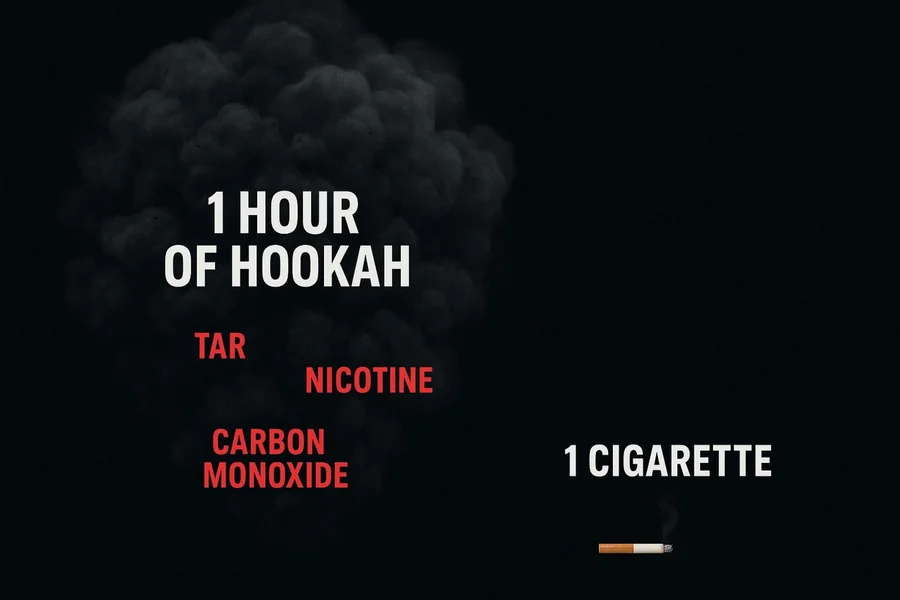
Research shows how big the gap can be: one hour of hookah smoking can involve about 90,000 ml of smoke, which is about 100 to 200 times more than the 500-600 ml from one cigarette. This much larger amount of smoke and the longer session time matter a lot for health risks, even though many people think the water makes it safer.
What Are the Contents and Ingredients Used?
Types of Tobacco and Flavors in Hookah
Hookah tobacco (often called shisha or ma’ssell) is usually moist and comes in many flavors like apple, mint, cherry, chocolate, coconut, licorice, cappuccino, and watermelon. Specialist shops such as Shisha Boutique carry a wide selection of these blends, making it easy to explore both classic and more unusual tastes. These flavors often come from mixing tobacco with molasses, honey, sugarcane, dried fruit, or fruit extracts. This gives the smoke a sweet smell and taste. Mint is one flavor that has been especially popular. Because the smoke can feel and smell less harsh than cigarettes, flavors play a big role in why hookah attracts younger users.
Additives and Charcoal in Hookah Use
Charcoal is a key part of hookah smoking. It provides the heat, but it also creates its own harmful chemicals. Burning charcoal produces high levels of carbon monoxide, heavy metals, and other cancer-causing chemicals. These add to what the user breathes in. Even “herbal” or tobacco-free shisha does not remove this risk, because the charcoal still burns and produces dangerous substances.
Comparison with Cigarette Ingredients
Even though hookah and cigarettes look and feel different, many of the harmful chemicals are similar-and some can be higher with hookah. Hookah tobacco is not less toxic than cigarette tobacco. Hookah smoke contains tar, carbon monoxide, heavy metals, and cancer-causing chemicals found in cigarette smoke. Because hookah sessions usually last longer, users are often exposed to more carbon monoxide and more total smoke. Some studies report hookah smoke can contain much more nicotine (in some cases, around 36 times) and higher levels of certain heavy metals than cigarettes. Nicotine is highly addictive, and hookah can deliver a lot of it, which supports dependence just like cigarettes do.
How Do Health Risks of Hookah Compare to Traditional Smoking?
Common Health Effects of Hookah Use
Hookah use can seriously harm health, and many risks match the dangers of cigarettes. Hookah smoking is linked to cancers such as lung, bladder, stomach, esophageal, and oral cancer. It also raises the risk of heart disease and lung disease. Carbon monoxide from charcoal can lead to poisoning. For pregnant people, hookah smoking is linked to low birth weight and a higher risk of breathing problems in babies. Also, because hookah is often shared, it can raise the chance of spreading infections like the flu, tuberculosis, herpes, hepatitis, and COVID-19, especially if the pipe is not cleaned well.
Toxins and Chemical Exposure: Hookah vs. Cigarettes
One of the most common myths is that hookah water removes toxins and makes the smoke safer. That is false. The water cools the smoke, which can make it feel smoother and less irritating, so people often smoke longer. But the water does not remove most harmful chemicals. Hookah smoke still contains tar, carbon monoxide, heavy metals, and cancer-causing substances. Because a hookah session often lasts much longer than smoking one cigarette, a user may take in almost 9 times more carbon monoxide and about 1.7 times more nicotine than from a single cigarette, creating higher overall exposure.
Secondhand Smoke: Hookah vs. Cigarettes
Hookah also creates secondhand smoke risks, similar to cigarettes. Hookah secondhand smoke includes chemicals from the tobacco and from the charcoal. So people nearby may breathe in carbon monoxide, heavy metals, and cancer-causing chemicals even if they are not smoking. Since hookah is commonly used in group settings like lounges, the amount of secondhand smoke exposure can be high for visitors and staff.
Myths about Hookah Being a Safer Alternative
Even with strong evidence, many people still think hookah is less harmful than cigarettes. Some studies show that a large share of hookah users-sometimes about 58.3% to 70% among daily users-believe it is less dangerous. This belief is often linked to the water, the pleasant flavors, and the fact that hookah feels more socially accepted in some places.
But health groups like the Mayo Clinic and the CDC state that hookah smoking is not a safe alternative to cigarettes. The tobacco is still toxic, the water does not remove most harmful substances, and long sessions often mean a larger dose of toxins. No form of tobacco use, including hookah, is safe.
Key Takeaways: Comparing Hookah and Traditional Smoking
Hookah may feel very different from cigarette smoking because it is often done in groups and is tied to tradition in some cultures. But the health risks are just as serious, and in some ways can be worse. Sweet flavors and the lounge setting can hide the fact that hookah smoke comes from tobacco and burning charcoal. This can make hookah attractive to young adults, including people who might not choose cigarettes. This return to tobacco use among non-smokers, along with the false idea that hookah is less harmful, creates a real public health problem.
Recent data shows youth hookah use has dropped over the last decade, which is good news. Still, ongoing action is needed. Programs aimed at youth, clear public messages, and strong tobacco policies are still needed. Possible steps include licensing all tobacco sellers, banning flavored hookah products, raising prices, and cutting marketing aimed at young people.
Public health campaigns also need to speak to different communities in ways that respect culture while still being clear about harm. No matter the method or flavor, tobacco use can cause serious health problems, and the safest choice is not to use it.