
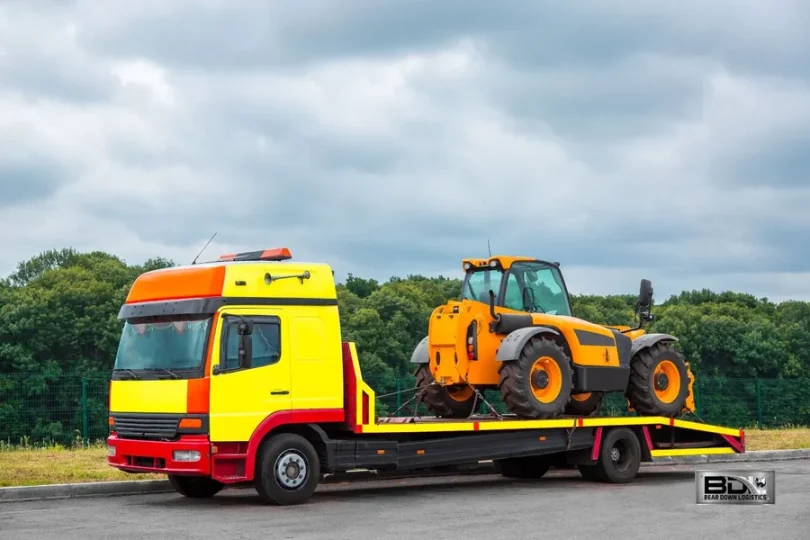

Cargo stability is essential in the heavy hauling industry to ensure public safety and protect fleet integrity. With rigs often weighing 80,000 pounds or more, loads must be properly secured to prevent rollovers, infrastructure damage, and legal issues caused by sudden braking, sharp turns, or uneven terrain.
The Critical Importance of Proper Load Securing
The consequences of an unsecured load are immediate and often unforgiving. When cargo shifts, it changes the vehicle’s center of gravity. In a heavy haul scenario, where loads often exceed standard dimensions and weights, a shift of just a few inches can make a trailer uncontrollable.
Beyond the obvious risk of accidents, improper securing leads to significant financial losses. Cargo damage claims can bankrupt smaller operators, and the downtime associated with investigations and repairs disrupts supply chains. Furthermore, regulatory bodies are vigilant. Roadside inspections that reveal insufficient tie-downs or damaged straps result in immediate out-of-service orders, halting operations and impacting a carrier’s safety rating.
Understanding Regulations and Standards
In the United States, the Federal Motor Carrier Safety Administration (FMCSA) sets the baseline for cargo securement. These rules are based on the North American Cargo Securement Standard Model Regulations. It is vital for every hauler to understand the specific performance criteria required by law.
The Performance Criteria
Cargo securement systems must be able to withstand forces associated with three specific deceleration/acceleration directions:
- Forward Direction:8 g (80% of the cargo weight).
- Rearward Direction:5 g (50% of the cargo weight).
- Lateral Direction:5 g (50% of the cargo weight).
Working Load Limits (WLL)
The aggregate working load limit of the tie-downs used to secure an article against movement must be at least one-half the weight of the article. For example, if you are hauling a 40,000-pound piece of machinery, the combined WLL of your chains or straps must be at least 20,000 pounds. It is crucial to note that the WLL is different from the breaking strength; relying on breaking strength figures rather than WLL is a common and dangerous mistake.
Equipment and Techniques for Load Securing
Selecting the right tool for the job is the first step in successful securement. In heavy hauling, the equipment must be robust and regularly inspected for wear and tear.
Essential Gear
- Chains and Binders: For heavy machinery and steel products, Grade 70 transport chain is the industry standard. Ratchet binders are generally preferred over lever binders because they offer finer tension control and are less likely to snap back and injure the operator.
- Synthetic Straps: These are ideal for loads that might be damaged by chains, such as palletized goods or finished surfaces. However, they are susceptible to cuts and abrasion, requiring the use of edge protectors.
- Dunnage: Wood or rubber mats placed under the cargo increase friction and help absorb vibration. Proper friction significantly reduces the number of tie-downs required to prevent forward and backward movement.
Direct vs. Indirect Tiedowns
- Direct Tiedowns: These attach directly to the cargo and then to the vehicle anchor points. This method is common for wheeled or tracked machinery.
- Indirect Tiedowns: These pass over the cargo to create downward pressure, increasing friction between the load and the deck. This is typical for stacked items or flat cargo.
The Role of Stability in Heavy Hauling
Securing the load to the deck is only effective if the load itself is stable. Stability refers to the resistance of the cargo to tipping or rolling over.
Center of Gravity (COG)
The most critical factor in stability is the Center of Gravity. High-COG loads are prone to tipping during cornering. Heavy haulers must place the load so that the COG is as low as possible and centered between the trailer tires. If a load is off-center laterally, it puts uneven stress on the suspension and tires, increasing the risk of a blowout or rollover during a turn.
Weight Distribution
Distributing weight correctly across the trailer axles is equally important. Overloading a specific axle group can lead to poor handling and braking performance. Drivers must understand the bridge formula and how to position heavy equipment to comply with axle weight limits while maintaining the vehicle’s handling dynamics.
Concrete Trailers and Specialized Challenges
Hauling concrete products presents a unique set of challenges that differ from standard machinery transport. Precast concrete beams, panels, and pipes are heavy, often oddly shaped, and can be brittle if not supported correctly.
A dedicated concrete trailer is often designed with specific bracing and lower deck heights to accommodate tall, precast walls while keeping the center of gravity manageable. The challenge here is twofold: keeping the piece on the trailer and preventing the piece from breaking under its own weight or due to road vibration.
When securing concrete, operators often use specialized “V” bunks for pipes or A-frames for panels. The tensioning must be firm enough to hold the concrete but not so tight that it cracks the product. Whether you are operating a standard flatbed or a specialized Shield hauler, utilizing softeners under chains and ensuring the dunnage is perfectly leveled is mandatory to prevent structural damage to the cargo during transit.
Technology and Innovations in Load Securing
The heavy hauling industry is seeing a wave of technological integration aimed at removing human error from load securement.
Digital Load Monitoring
New sensor technology allows drivers to monitor strap and chain tension from the cab. If a load settles and a strap becomes loose during transit—a common occurrence—the driver receives an immediate alert. This allows for timely corrective action before a safety hazard develops.
Electronic Stability Control (ESC)
Modern trucks and trailers are equipped with advanced ESC systems. These systems detect when a vehicle is approaching a critical instability point, such as the beginning of a rollover or jackknife. The system automatically applies braking to specific wheels to help the driver regain control. While this doesn’t replace proper cargo securement, it acts as a vital safety net for heavy or high-COG loads.
Conclusion
The margin for error in heavy hauling is vanishingly small. A successful transport operation relies on a comprehensive approach that combines strict adherence to FMCSA regulations, the use of high-quality chains and binders, and a deep understanding of load physics.