


Most businesses do not have a writing problem. They have a volume problem.
A single product launch now needs a landing page, three social posts, an email sequence, a sales deck, a product image set, a short video, and often a translated version of half of that. The idea takes an hour. The formats take a week.
That gap is what has pushed content teams toward a different kind of tool.
Where Content Work Actually Breaks Down
The bottleneck is rarely the first draft. It shows up in the handoffs.
- Format conversion. A finished blog post becomes a LinkedIn post, then a slide, then an email. Each version is built manually from the last, usually by copying text into a different application and reformatting it by hand.
- Scattered assets. The research sits in one tool. The draft sits in a doc. The images live in a design app. The final deck is attached to an email somebody sent last Tuesday. Nobody can find the current version without asking.
- Inconsistent output. When five pieces of content are produced in five different tools by three different people, tone drifts. So do colors, headline styles, and the way the product gets described.
- Repeated context. Every new tool starts from nothing. You re-explain the audience, the product, and the goal each time you open a different application.
None of these are creative problems. They are logistics, and logistics is where most content budgets quietly go.
What an AI Workspace Changes
An AI workspace keeps the whole content process in one environment, where each stage can build on the last instead of starting over.
Professionals who want to understand the technologies behind these applications can strengthen their knowledge through an AI/ML course covering artificial intelligence fundamentals, machine learning techniques, and practical applications of AI in business.
The practical difference is context. In a collection of separate tools, your research and your draft and your slides know nothing about each other. In a connected workspace, the research informs the draft, and the draft becomes the source for every format that follows.
That single change removes most of the copying, reformatting, and re-explaining that eats the working day.
Turning One Idea Into Several Formats
This is where AI content creation earns its place in a business workflow.
Start with a piece of research on a topic your audience cares about. From that same base, a workspace can produce:
- A long-form article or report
- A condensed version for email
- A slide deck for a client or internal meeting
- Supporting images and short video clips
- A translated edition for another market
The point is not that AI writes all of it. The point is that each format starts from material that already exists, rather than from an empty page. A marketer who used to spend two days converting a report into a campaign can get to a reviewable version in an afternoon.
The review still matters. Every output needs a human pass for accuracy, tone, and whether it actually says something worth reading.
Managing Content After It Is Created
Creation gets most of the attention. Management is where the time leaks.
Businesses producing content weekly accumulate hundreds of files across drafts, versions, images, and decks. Without structure, teams recreate work that already exists because nobody could find it.
Workspaces built around projects rather than individual files handle this better. Documents, generated assets, and prior conversations stay attached to the project they belong to. Six weeks later, when someone asks whether a version of the Q3 deck exists, the answer takes seconds instead of a Slack thread.
This is a quieter benefit than generation speed, and for teams producing at volume, often a larger one.
Oreate AI as a Content Creation Workspace
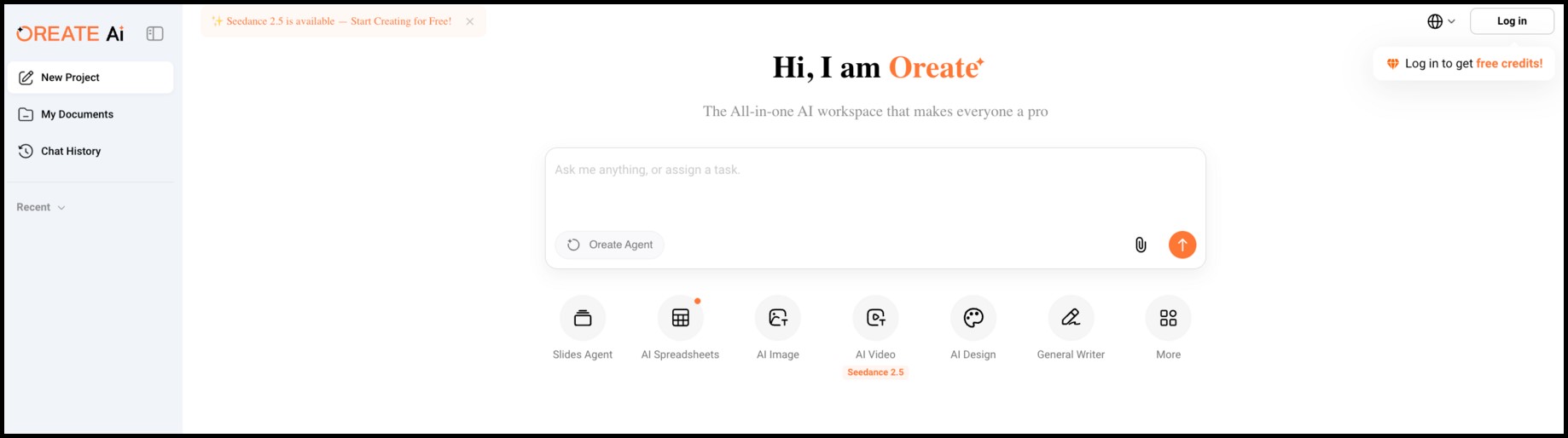
Oreate AI is one platform built around this connected model rather than a single content function.
Its workspace organizes work by project, keeping documents, files, and chat history together so material stays accessible across stages. The toolset covers most of the content lifecycle:
- Deep Research for gathering and organizing sourced information
- General Writer for drafting articles, reports, and long-form content
- AI Image, AI Video, and AI Design for visual assets
- Slides Agent and the AI presentation tools for converting written material into decks
- Paraphraser and Humanizer for reworking existing text
- AI Translator for multilingual versions
Breadth is both the appeal and the trade-off. A platform covering this many functions will not match a dedicated specialist in any single discipline. For teams whose main constraint is producing across formats rather than perfecting one, that trade often makes sense.
As with any AI productivity tools, outputs need checking before they reach a customer. That applies to generated statistics and citations especially.
What AI Still Cannot Do for Content Teams
Worth saying plainly, because the gap matters more than the capability.
AI does not know what your customers actually asked last quarter. It does not know which objection kills your deals, which phrase your competitor already owns, or why the campaign you ran in March underperformed. It produces competent, structurally sound content that sounds like everyone else’s competent, structurally sound content.
The parts that make content worth publishing are the specific example, the honest caveat, the opinion someone might disagree with. Those come from people who know the business.
Teams getting real value from business AI tools treat them as production capacity, not editorial judgment. The tool handles the volume. The human decides what is worth saying.
Frequently Asked Questions
Is an AI workspace different from just using ChatGPT?
Yes, mainly in continuity. A chat tool handles one prompt at a time and starts fresh each session. A workspace retains project files and prior work, so material carries forward between research, drafting, and final formats.
Do small businesses benefit, or is this for larger teams?
Small teams often benefit more. A three-person company without a designer or a research analyst gains more from broad capability than a large organization with specialists in each role.
How do you keep AI-generated content from sounding generic?
By treating the output as a first draft rather than a finished piece. Add specific examples, customer language, and a point of view. The structure comes from the tool. The substance has to come from you.
Should businesses disclose that content was AI-assisted?
Practice varies by industry and platform. Some publishers require it, and some client contracts address it directly. Check the expectations of wherever the content will appear before assuming either way.
Conclusion
The shift is less about AI writing content and more about removing the friction between the idea and its finished formats. An AI content creation platform that keeps research, drafting, visuals, and presentation work connected saves the hours that used to go into moving material between applications.
What it does not do is replace judgment. AI has made producing content cheap. That makes deciding what is worth producing more valuable, not less.
For teams that spend more time reformatting work than creating it, that is the specific problem worth solving first.