
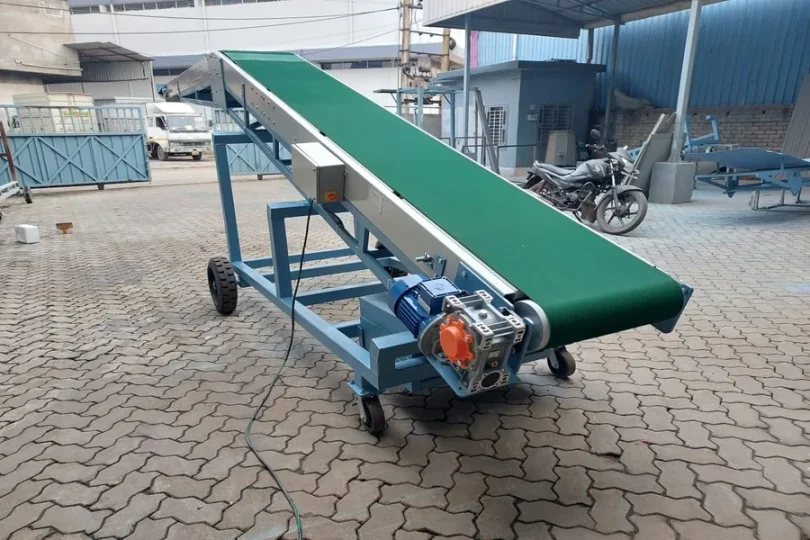

Inclined transport introduces a different set of engineering challenges compared to horizontal conveying. Gravity works against motion, products can shift or roll backward, and load distribution changes as material climbs. In facilities where vertical space is limited and floor space must be used efficiently, inclined conveyors become essential links between processing stages. When they underperform, the consequences show up quickly in product rollback, belt slippage, uneven feeding, and premature wear.
A cleated belt conveyor is specifically designed to address these challenges. By integrating cleats — raised sections attached to the belt surface — the system creates physical barriers that help secure product during ascent. However, the presence of cleats alone does not guarantee reliable performance. The engineering decisions behind belt selection, cleat configuration, drive control, and structural alignment determine whether the conveyor operates smoothly or becomes a recurring maintenance issue.
This article outlines eight engineering factors that directly influence cleated belt conveyor performance in inclined systems. The emphasis is on real operational outcomes: load stability, reduced downtime, and consistent throughput.
1. Belt Material Selection and Surface Characteristics
The belt itself forms the foundation of the system. In a cleated belt conveyor, the base belt must provide both structural strength and appropriate friction characteristics. Material selection affects flexibility, resistance to abrasion, and compatibility with environmental conditions such as moisture, heat, or chemical exposure.
For inclined systems, surface friction is especially important. If the belt surface is too smooth relative to the product base, items may slide backward between cleats. If it is too aggressive, product transfer at discharge points may become inconsistent.
Engineering considerations include:
- Matching belt flexibility to pulley diameters to prevent cracking
- Selecting materials resistant to the product’s weight and edge profile
- Ensuring compatibility with washdown or dust-prone environments
A belt that maintains structural integrity under repeated bending cycles prevents early fatigue and tracking issues.
2. Cleat Design, Height, and Spacing
Cleats serve as mechanical supports that prevent material rollback during incline transport. Their geometry directly influences load retention and discharge behavior.
In inclined conveying, cleat height must correspond to product dimensions and mass. Cleats that are too low may allow product to slide under gravity, while excessively high cleats can interfere with smooth discharge at the head pulley.
Spacing also matters. Proper spacing ensures that:
- Product rests securely between cleats without excessive compression
- Material does not bridge between cleats in bulk handling applications
- Load weight is distributed evenly across the belt
Cleat attachment integrity is equally critical. Poor bonding or mechanical fastening can lead to detachment under load, which introduces contamination risk and unplanned downtime.
3. Incline Angle and Load Stability
The angle of incline determines the gravitational force acting against the conveyed material. As the incline increases, the tendency for product rollback grows. Engineering design must account for the relationship between incline angle, cleat geometry, and product characteristics.
At moderate inclines, friction between belt and product may suffice when supported by cleats. At steeper angles, the cleats bear a greater portion of the load force. Excessive incline without proper cleat design can lead to:
- Increased stress at the cleat-to-belt interface
- Uneven load pressure at the lower end of the belt
- Higher tension requirements at the drive system
Balancing incline angle with belt and cleat configuration ensures predictable transport without overstressing components.
4. Drive System Sizing and Torque Control
Inclined conveyors demand greater drive torque than horizontal systems because the motor must overcome gravitational resistance. A cleated belt conveyor operating on an incline must be engineered with adequate drive capacity to handle both steady-state and start-up conditions.
Drive sizing considerations include:
- Anticipated load mass at maximum capacity
- Start-up torque required to move stationary product uphill
- Controlled acceleration to prevent sudden load shift
If the drive system is undersized, belt slippage or motor overload can occur. If acceleration is too abrupt, products may jolt against cleats, increasing wear and potential misalignment.
5. Belt Tracking and Alignment Mechanisms
Tracking stability is fundamental in any conveyor system, but inclined systems amplify tracking errors. Gravity introduces lateral forces that can cause the belt to drift if alignment is not precise.
A cleated belt conveyor must incorporate:
- Properly aligned pulleys and idlers
- Adequate tensioning systems to maintain belt centering
- Structural rigidity to prevent frame deflection under load
Misalignment leads to uneven wear along belt edges, premature cleat damage, and potential spillage. In severe cases, persistent tracking errors can cause belt edge fraying or structural failure.
Routine inspection and precise installation reduce long-term tracking issues and maintain consistent belt position during operation.
6. Load Distribution and Feed Consistency
How product enters the conveyor significantly affects performance. Uneven loading at the infeed can create localized stress and imbalance that persists along the incline.
Engineering measures to manage feed include:
- Ensuring centralized product placement on the belt
- Designing feed chutes that align material with cleat spacing
- Avoiding overloading beyond rated capacity
When load distribution is consistent, tension across the belt remains uniform. This uniformity reduces wear at specific linkages and prevents oscillations that can develop when one side of the belt carries more mass than the other.
In bulk handling scenarios, uneven feed can cause material to pile against one cleat face, creating asymmetrical pressure that degrades cleat attachment points over time.
7. Discharge Geometry and Product Release
Performance is not only defined by how material ascends but also by how it exits the conveyor. The head pulley and discharge angle determine whether product releases cleanly or experiences hesitation.
If cleats are not configured to align with the head pulley curvature, material may:
- Accumulate temporarily before discharge
- Drop unpredictably, affecting downstream equipment
- Experience additional impact that damages fragile items
Discharge geometry must ensure that as the belt wraps around the head pulley, gravity assists in release without causing backward drag on remaining material. This coordination reduces stress on cleats and prevents carryback.
8. Maintenance Accessibility and Environmental Controls
Inclined conveyors often occupy elevated positions within a facility, which can complicate inspection and maintenance. Engineering design should provide safe access to critical components such as tensioners, drive units, and belt surfaces.
Environmental factors — including dust, moisture, and temperature variation — influence maintenance frequency. Design considerations include:
- Selecting belt materials resistant to environmental degradation
- Protecting cleat attachment areas from chemical exposure
- Incorporating covers or guards to limit debris accumulation
Maintenance planning should anticipate real conditions rather than ideal ones. Accessibility reduces downtime because adjustments can be made promptly and safely.
Integrating Engineering Factors Into Reliable Performance
Each of the eight factors above interacts with the others. For example, a steeper incline requires stronger cleats and higher drive torque, which in turn increases tension demands and alignment sensitivity. Likewise, feed consistency affects load distribution, which influences belt tracking and wear patterns.
Designing a reliable cleated belt conveyor involves balancing these variables rather than optimizing a single dimension. Engineers must consider:
- The nature and variability of the product
- Production throughput expectations
- Environmental exposure
- Maintenance capability within the facility
When these considerations are addressed during system design rather than after installation, inclined transport becomes predictable rather than problematic.
Conclusion
Inclined transport systems introduce forces and stresses that do not exist in horizontal conveying. A cleated belt conveyor provides the structural features needed to counteract gravity and maintain product stability, but its performance depends on thoughtful engineering decisions.
Belt material, cleat geometry, drive torque, alignment accuracy, load distribution, and discharge design each influence operational reliability. Neglecting any of these factors can lead to rollback, uneven wear, or unexpected downtime. Addressing them systematically creates a conveyor system that supports consistent throughput and reduces the risk of failure.
For plant engineers and system designers, understanding these eight engineering factors provides a practical framework for evaluating and optimizing cleated belt conveyor performance in inclined applications.