
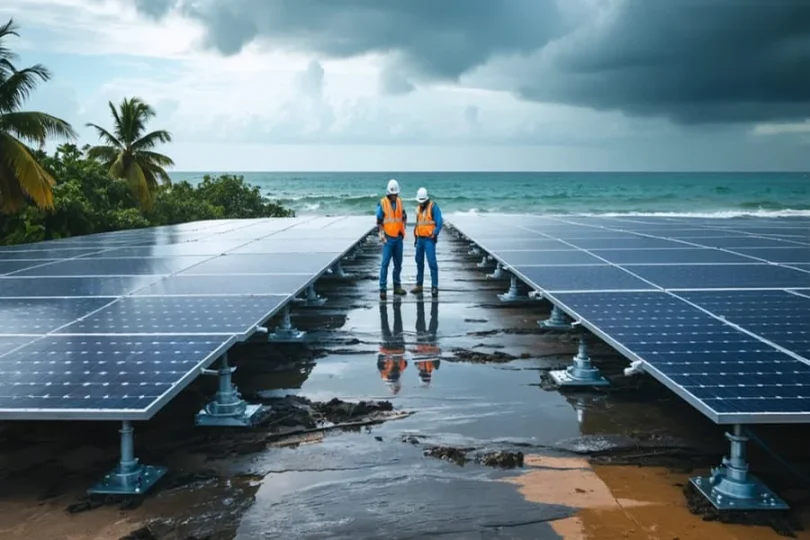

Coastal and high-humidity regions offer plenty of sunlight year-round, but the environment introduces variables that can reduce solar panel efficiency if not accounted for. Humid air often carries salt, fine sand, and organic particles that settle on glass surfaces, reducing light transmission. Morning dew and frequent mist can leave a thin film that traps dust, creating a layer that blocks the spectrum the panels need most. In many seaside climates, cloud cover also behaves differently, shifting quickly with sea breezes and producing bright, hazy skies that reduce direct sun even when the day feels sunny. Heat matters too. When humidity is high, modules can run warmer because evaporative cooling is limited, and higher cell temperatures reduce voltage output. None of these effects means solar is a poor fit for coastal homes, but they do mean performance depends more on material choices, mounting details, and maintenance habits than homeowners might expect. Understanding these local influences helps set realistic expectations and keeps production more consistent across seasons.
Why coastal conditions change solar performance
-
Salt, corrosion risk, and hardware longevity
Salt spray is one of the biggest coastal challenges because it accelerates corrosion in metal parts and increases the chance of electrical connection issues over time. The panel glass itself is usually durable, but racking, clamps, fasteners, and grounding hardware can degrade if the wrong materials are used. Even when components are rated for outdoor exposure, constant salt exposure can stress coatings, leading to surface pitting or rust staining that indicates deeper wear. Junction boxes, connectors, and cable jackets can also suffer if salt and moisture collect in areas with poor drainage. For installers, good practice often includes choosing corrosion-resistant hardware, managing cable runs so they do not trap moisture, and keeping dissimilar metals from creating galvanic corrosion points. Coastal installations benefit from careful torqueing and sealing practices because tiny gaps can become pathways for saltwater. Many crews, including North Valley Solar Power, advise homeowners to schedule periodic visual inspections of attachment points and wiring integrity because early detection of corrosion prevents small issues from becoming production losses or safety concerns later.
-
Humidity, condensation, and soiling patterns
High humidity affects solar efficiency in subtle ways that go beyond temperature. Condensation forms more often on cool mornings, especially when overnight temperatures drop, and the roof surface cools faster than the surrounding air. That moisture layer can catch airborne particles, including soot from traffic, pollen, or fine salt aerosols, creating a sticky film that does not always rinse off in light rain. Over time, this builds up into soiling that reduces production, particularly during the early hours when the sun angle is low, and light passes through a longer atmospheric path. If the array has a shallow tilt, water can remain on the surface longer and leave mineral spots as it dries. Coastal environments can also promote algae or biofilm growth on nearby roofing materials, and wind can transfer these particles to the panel surface. This does not typically damage the panels, but it can reduce output enough that homeowners notice a gap between expected and actual production. The solution is not constant cleaning, but targeted maintenance timed to local conditions, such as after heavy pollen seasons or long dry stretches.
-
Wind, storms, and mechanical stress considerations
Coastal regions often experience strong winds, sudden squalls, and exposure to tropical storms, which shift attention to mechanical design. Panels act like aerodynamic surfaces, and uplift forces can be significant during gusts, especially on elevated roofs or open coastal lots. Racking systems must be engineered for local wind speeds, and attachment points must be installed in structural members with proper flashing and sealing to prevent water intrusion. When hurricanes or cyclones are part of the regional risk, installers may choose to install additional attachment points, stronger rails, or specific mounting patterns to reduce uplift. Salt and humidity also interact with mechanical stress, as corroded fasteners can weaken over time; durability is not only about initial strength but also about maintaining it for decades. After major storms, a quick inspection is wise even if the system appears intact. Microcracks can form in cells due to impact or vibration, and loose clamps can shift modules slightly, altering grounding contacts or wire strain. This type of preventive check supports both safety and long-term production stability.
Keeping coastal solar output stable year after year
Salt exposure, frequent condensation, soiling patterns, heat, and storm-related mechanical stress shape solar panel efficiency in coastal and high-humidity regions. These factors can reduce output if ignored, but they can also be managed with thoughtful equipment choices, solid mounting practices, and reasonable maintenance. Corrosion-resistant hardware, good airflow under panels, careful cable routing, and strong attachment design all improve long-term reliability. Monitoring data helps homeowners distinguish normal weather-driven variation from problems such as heavy soiling, new shading, or connection issues. Gentle cleaning timed to local conditions can restore light transmission without damaging surfaces, and post-storm inspections protect both safety and performance. Coastal solar is not about chasing perfect numbers every day, but about building consistency year over year in a demanding environment. When the system is designed for salt and humidity from day one and maintained with simple habits, homeowners can enjoy strong performance, dependable operation, and a system that remains resilient in the very conditions that make coastal living unique.